House of Ideas
Academic EnTeam Game
Purpose
House of Ideas strengthens skills in combining ideas from different people to build a logical structure of ideas or a reasonable plan of action.
This game is a sequel to House of Cards.
Requirements
- Time: 30-40 minutes for a match (each individual game is 5 minutes or less)
- Number of Players: 2 or more
- Age range: old enough to compare ideas and describe ideas
- Space: online or in-person
- Equipment: Paper, pencils, and a statement of an objective or problem to solve (scoresheets are optional)
- Prerequisites: willingness to listen and explore for solutions
How to Play
- Start with an objective or problem to solve that is relevant to the group.
- Organize teams with 2, 3 or 4 players per team. (See options below.)
- Confirm that everyone understands the topic. Explore the issue informally.
- Start the clock for game 1.
- Player A contributes an idea.
- Another player writes a brief description of the idea.
- Player A confirms or corrects the description.
- Another player, B, contributes a second idea.
- B describes how the new idea connects to the first idea.
- Another player writes a description of the idea and the connection.
- Player B confirms or corrects the description.
- Players continue contributing and writing ideas until time is up.
- Player A contributes an idea.
- When time is up, record scores and debrief on how to improve the score.
- Debrief ideas are presented below.
- The length of time for the debrief depends on the objectives for the game.
- Repeat the sequence as many times as needed. Use at least 2 rounds for Group-Best scoring. Use at least 3 rounds for All-for-One scoring.
Scoring methods — EnTeam games use Group-Best scoring which adds the scores of all the teams together to create one group score. The teams win together if the group score improves each time they play. Below are several suggestions for scoring each team.
Brainstorm scoring: Count the number of ideas that are written by a partner. If the scores improve game after game, the players win together. If the scores don’t improve, the players lose together.
Collaborative scoring: Partners score one point for each pair of ideas provided both partners write different ideas to the question. A solo participant scores one point for each idea to a solo question, provided other rules are followed.
- For example, if Partner A writes four ideas and Partner B writes one idea, their score is one because they have only one pair of ideas with two authors. Both partners have a score of one.
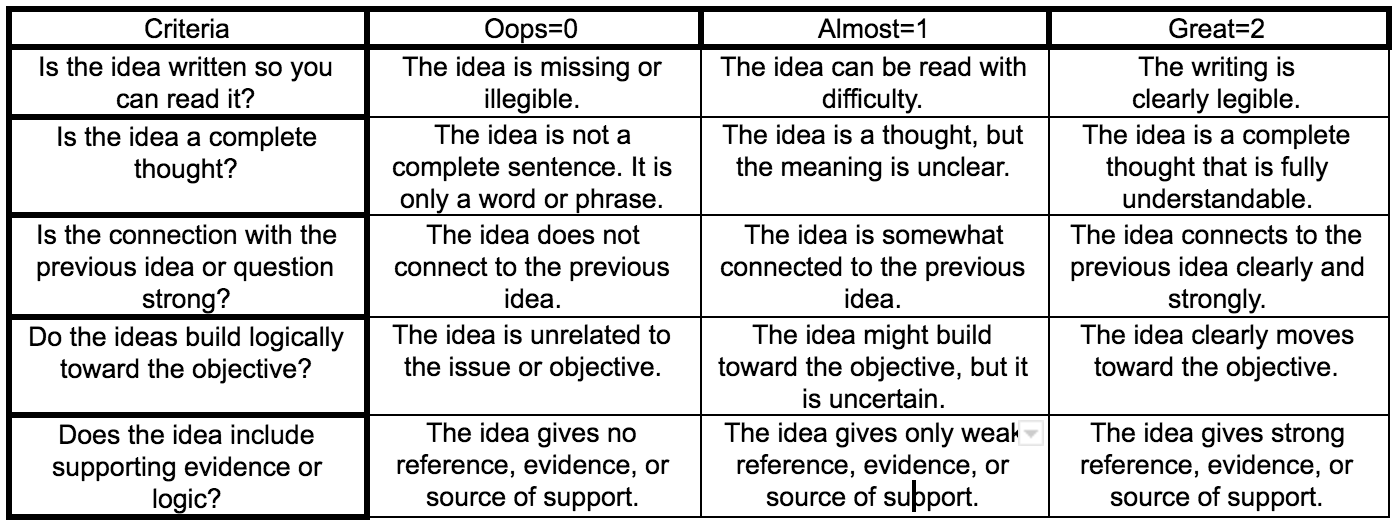
Quality scoring: Sample Rubric (10 points possible per written idea)
All-for-One scoring — use EnTeam score sheets
- Teams of 3 people: two partners interview each other in each of three games. During each game, one of the members is observer and scorekeeper.
- Teams of 4 people: two partners interview each other in each of three games. Both interviews take place simultaneously.
- See the EnTeam Manual for a full explanation of EnTeam score sheets and All-for-One scoring.
Sample problems suitable for House of Ideas
- How can we help new students feel welcome, safe, and included?
- What steps do we need to take to complete our project on time?
- How can people who are homeless secure housing?
- What could we do to make our next social event enjoyable for everyone?
Instructions for Players
- Before the game, players have time to discuss the question.
- The time for the discussion is set by the facilitator.
- The only ideas that count in the score are ideas written during the game.
- During the game, each player has a turn suggesting ideas for finding the solution to the issue. Also, each player writes their partner’s ideas.
- For your ideas to count in the score for the game, a partner must write your ideas.
- If you write your own ideas, they do not count in the score.
- You need to check that your ideas have been written correctly.
Game score
[Insert the scoring method that the facilitator has chosen]
Debrief Questions
The purpose of debriefing is to develop strategies that will improve your performance and to recognize how these lessons apply to everyday life. To facilitate a successful debrief, facilitators must observe participants and ask engaging questions that spark thoughtful reflection. If we don’t debrief, we don’t learn!
What happened?
What did you see? What did you hear? What was the score?
What worked? What didn’t work?
How did people feel? What issue(s) came up? What issue(s) remain?
So what?
What did we learn?
How does this experience relate to other experiences?
Why are we doing this? How is it relevant to us?
Now what?
How could we improve our score in this activity?
How can we work together better?
How could we apply lessons learned outside of the game?
Digging Deeper
- Did anyone feel reluctant to share strategies?
- Why? Are you still in a win-lose mindset?
- If we are trying to improve collective achievement, who are you benefitting when you withhold strategies from other teams?
Debrief Chart (PDF)
Online House of Ideas Packet (PDF)